By: Eleni Dimitrakos | Editor-in-Chief
I would like to preface with acknowledging and appreciating the delicacy of this article. I would like to inform readers that as a journalist, my intention here is to simply cover the fact that this discourse was occurring on our campus. It is my hope that by writing this article, I am allowing each party to have a voice and that people will therefore be able to make their own independent, intellectual decisions on how to respond to any conflict happening on our campus surrounding this topic. I am, in no way, choosing sides, vouching for any particular party, or attacking anyone involved.

Over the past month and a half or so, Salve has seen the introduction of a new club on campus and this has caused some controversy to arise. Turning Point USA is an organization founded by Charlie Kirk in 2012. “The organization’s mission is to identify, educate, train, and organize students to promote the principles of fiscal responsibility, free markets, and limited government” (tpusa.com). The initial message on Turning Point’s official website is “Charlie’s vision. America’s Future. The fight continues.” Furthermore, “Turning Point USA guides citizens through development of knowledge, skills, values, and motivation, so they can meaningfully engage in their communities to restore traditional American values like patriotism, respect for life, liberty, family, and fiscal responsibility” (tpusa.com).

Salve Regina University, as we all know, was founded by Catherine McAuley and the Sisters of Mercy and “seeks wisdom and promotes universal justice. The University, through teaching and research, prepares students for responsible lives by imparting and expanding knowledge, developing skills and cultivating enduring values” (salve.edu). Salve prides itself on cultivating a welcoming, accepting environment where diversity is not only accepted, but cherished.
Though, just because Salve fosters diversity, it does not mean the campus fosters division. Of any kind.
Recently, students have been quite upset at the presence of a TPUSA chapter and club on Salve’s campus. Especially at a tabling event TPUSA held, at which they posed the question “Do men belong in women’s sports?” with the tally options “Yes,” “It Depends,” and “No.” Students began mentioning this event everywhere on campus, and mainly with a negative connotation. I know of multiple members of Salve’s Alliance Club and students who identify as members of the LGBTQIA+ community in general, that mentioned how this specific event made them feel not only unwelcome on campus, but unsafe. Because of this event, a petition was created by Junior Theatre Arts and Music double major Eliza Eschenbrenner. I was able to sit down with Eliza as well as Junior Psychology and Musical Theatre double major, Kendra Obrycki, both of whom have been active throughout this discourse.* This conversation took place on October 23rd.
Eleni: Before we even get to the petition, I just want to know why, for the both of you, it’s important for you to speak out about the discourse happening on our campus.
Eliza: I think particularly being president of StageFright, our on-campus theatre club, the certain issues that Turning Point USA goes against is kind of everything that the majority of our StageFright E-Board agrees with; that’s important to me to speak out on behalf of everyone in my club. As well as being part of the LGBTQ+ community and being an Ally to all of my friends who I know that Turning Point USA strongly opposes. I think that’s the main thing for me: speaking up for those who might not be able to or are too afraid to put their name on anything and for the theatre and music community.
Kendra: Salve is a very inclusive place and that’s why I chose to come to Salve. I fully believe in the Mercy Mission and fully believe that we are responsible to shed light and help those who cannot help themselves. At every single turn, if you look at TPUSA’s founder and what that says, and what the chapter of the club stands for, it goes against everything that Salve is. I know a lot of students that have expressed concern, expressed worry for themselves and not being able to be their true selves on campus because these people are here. Being able to further help people and help show action that this is not okay to be here because it doesn’t align with what we stand for as an institution.
Hearing about how both Eliza and Kendra personally relate to and reacted to the introduction of TPUSA on campus, I was eager to find out why Eliza decided to take further action.
Eleni: Eliza, why start a petition specifically?
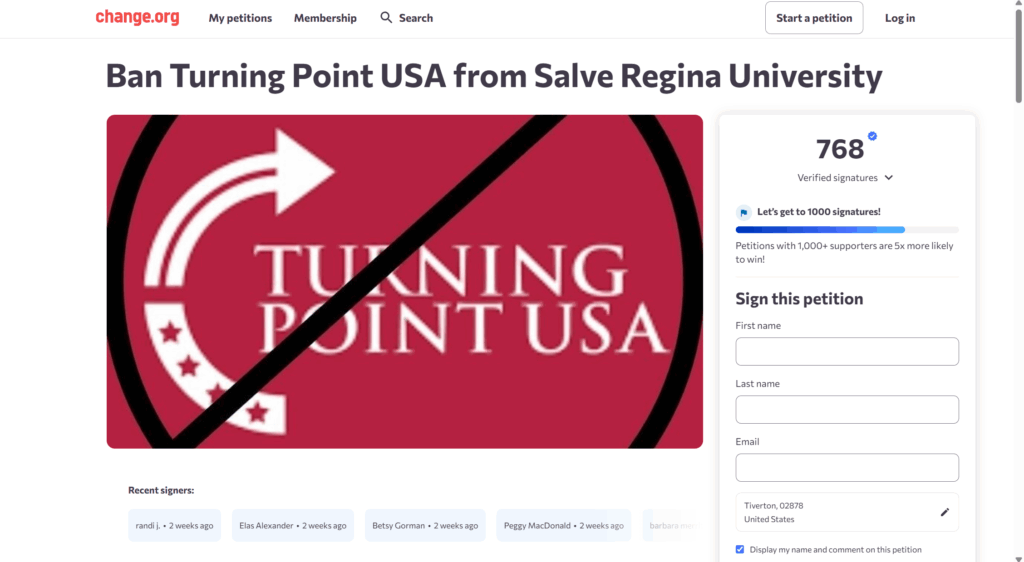
Eliza: The idea of the petition is to show that there’s a massive amount of support behind the idea that Turning Point USA should not be on our Mercy founded campus. There are 714 signatures right now and that includes current students, alumni, faculty, staff, and family members.
Kendra: The other thing with the petition is that people can add messages to it and fully explain why they’re signing it and why this is so important and critical to us right now.
Eliza and Kendra are partnering with some other students on campus and have come up with a plan should the petition not be recognized by Salve. This plan has many further steps, but will only be enacted should the petition not be recognized. But for the time being, the petition is still very much active and is currently at 768 signatures.
Eliza mentioned that she sent an email to Colton Johnson and in this email, she stated that, “By using the carefully worded question “do men belong in women’s sports?” they proved their club to be transphobic and homophobic. Contradictorily, Kelli Armstrong herself made an Instagram reel collaborating with the Gay Straight Alliance. This is very confusing to, and harmful of the safety of Salve’s LGBTQ+ community, myself included. Having a campus that embraces differing sexualities and diversity, is what made me choose Salve in the first place. This club does not represent the Salve that I know and have come to love deeply.” She also mentioned that she would be meeting with Colton the next day to discuss her concerns.
Eleni: How do you see Turning Point interacting with already existing clubs on campus and with our campus in general? Do you have any concerns with the way that they are interacting with pre-existing clubs on campus?
Eliza: Oh very much so.
Kendra: In our meeting last night, the point of Alliance was brought up. They were told that they couldn’t have their “Coming Out Day” on that specific day that Turning Point was outside Gerety because there was a pre-existing thing. Alliance has been a club for much longer than Turning Point USA—
Eliza chimes in.
Eliza: And they do that event ever year.
Kendra: They do that event every year. It’s consistent, it’s always that week, it’s always around that time and they got told they couldn’t do it. The other thing with Alliance: a bunch of Alliance members, including their president, were featured in a photo that TPUSA took and they posted that photo. A day later, that Alliance president messaged them and said, “Hey, I don’t want to be on your page, take it down” and they replied “no.” I’m pretty sure that the Alliance president had to go talk to Colton to get them to take it down.
Another thing Kendra went on to mention was how TPUSA was interacting with Salve members of the campus.
Kendra: I know that personally, a lot of my friends and myself were very offended by what they had in their first public showing to the campus. Their question of “Do men belong in women’s sports?” That is a poorly phrased question—we know what they’re trying to get at and doesn’t make it right. A lot of people of are uncomfortable. Maybe they’re not saying or doing anything, but their presence, because of what they have stood for. When arguments are brought forward to them or debate are brought to them, they are severely uneducated in what they are talking about.
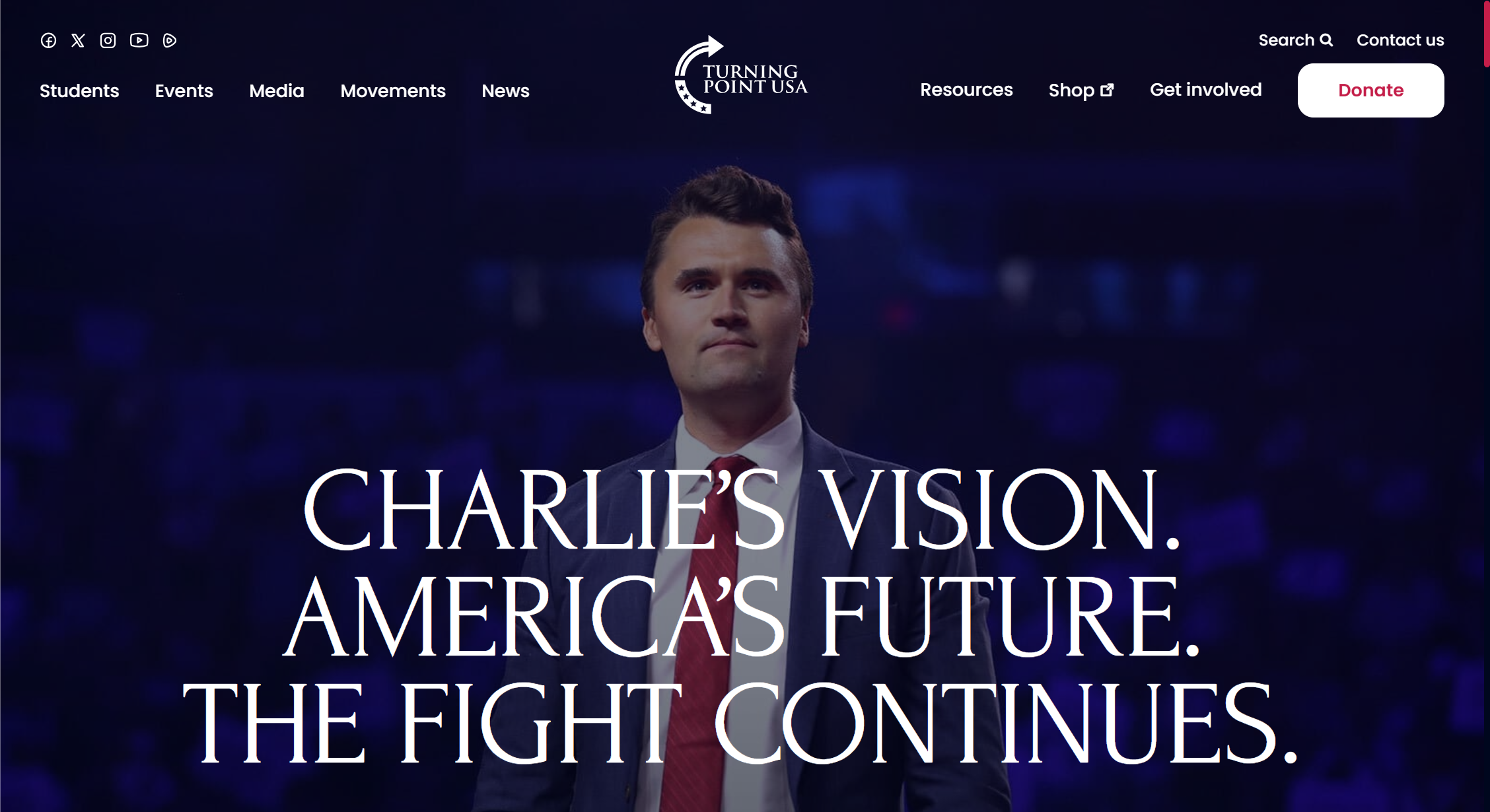
Eliza: Turning Point USA’s slogan is “Charlie’s Vision, America’s Future.” Their club has to abide by Turning Point USA’s rules. If they have to abide by Turning Point USA’s rules and Turning Point USA’s slogan is “Charlie’s Vision, America’s Future,” then it’s like… you’re directly going for his vision, meaning that they should agree with all of these things.
Kendra: I’m at a 50-foot distance from anything that they have done. But just at a 50-foot distance from what they’ve posted, what they’ve used their free speech to do, more incites hate than incites love. [They’ve been] using religion as a means of putting a shield up against them to say that “everyone else is being hateful to us and we’re just using Jesus.” Which is not what they’re actually doing; and to do that at a Mercy Institution, an institution that is religious is very hurtful. Not only to the institution, but to a lot of the students that do identify as religious. It is blatantly saying that you do not understand religion if you do things like that.
The conversation at this point had shifted slightly to the lack of response from the TPUSA E-Board’s end regarding certain Instagram comments that had been made.
Eliza: One of the points that I wanted to bring up was, why don’t we try to talk to their E-Board? Oftentimes, when I talk to far-right leaning people, it’s more so they don’t understand what they’re blindly following, rather than doing the research and then backing their beliefs with evidence. I would rather just try to peacefully talk to them.
Eleni: Are you thinking of reaching out to them in some capacity?
Both Eliza and Kendra said that they would want to.
Kendra: I would email them first. And if they responded, great, and then maybe set up a time to meet. But if they don’t…
Eliza: Then we’ll still go on.
Eliza later let me know that she did eventually reach out and the E-Board actually directed them to this article that was to be written. As of yet, the TPUSA E-Board has yet to agree to meet with Eliza and Kendra outside of one of their own meetings.
Eliza: They have Instagram takeovers and they posted “ask any question.” I put two questions, but one of them was “Please state how Charlie Kirk uplifted the Mercy Mission. Please provide evidence.” They haven’t responded to it.
Kendra went on to say that they had a meeting with some other people the night before who had brought some concerns forward about the organization. And Eliza added that this is where they laid out the steps for if the petition is not recognized.
Eliza: One thing we talked about yesterday was how at the very least we wanted to de-fund them from being a part of our clubs and activities. That’s in our tuition, so we’re all technically funding TPUSA. If we cut them off from university funding, they would still get funding from Turning Point USA. Since we are a private school, I feel like we have the ability to—
Kendra chimes in.
Kendra: To say we don’t want our money going to them. They can still legally be on this campus, they can organize on this campus, they can have their meetings in O’Hare if they so choose. But as students, we are not sending our money, our funds, to an organization that we stand against, because it shouldn’t be, in our vales, something that we all wanted as a Mercy Institution.
Eliza: It doesn’t support the Mercy Mission, so why should we fund it?
We ended our interview with me asking Eliza and Kendra if they had any final thoughts or comments that they would like to be mentioned in this article. They both just thanked the Mosaic for being willing to shed light on this discourse.
***
With the hope of writing an article giving each side a voice, I thought that it would also be crucially important to sit down with the E-Board of Turning Point and have a conversation with them as well. On October 27th, I did get the opportunity to interview the E-Board.
Salve’s TPUSA E-Board consists of three Freshmen: Sophia Guzik (President and Finance Major), Cayden Ratineri (Vice President and Finance Major/Music Minor), and Erica Furdon (Secretary/Treasurer and Psychology Major).*
Eleni: How did you become interested in TPUSA and why did you want to bring it to Salve?
Sophia: After the assassination of Charlie Kirk… I messaged Cayden and we had previously had discussions on Snapchat about issues and being in similar alignment.
Sophia shared that both she and Cayden had been thinking of starting a TPUSA at Salve and decided to work together. They later found Erica and decided to reach out to her, bringing her into the process. Because they are all freshmen, I was curious about their process to start a new chapter and club.
Eleni: What was the process like to start a new chapter and club, especially since you’re all freshmen?
Sophia: It was kind of just in the heat of the moment. There are Turning Point USA Representatives and we have a rep [representative] for all of New England. I reached out to her and she sent me the paperwork to get signed up through Turning Point, the organization. Then I emailed the Student Government and I asked about how we could become recognized. We had to explain what our club is, what we would do, they had to get it approved, send our constitution… just basic mandatory work.
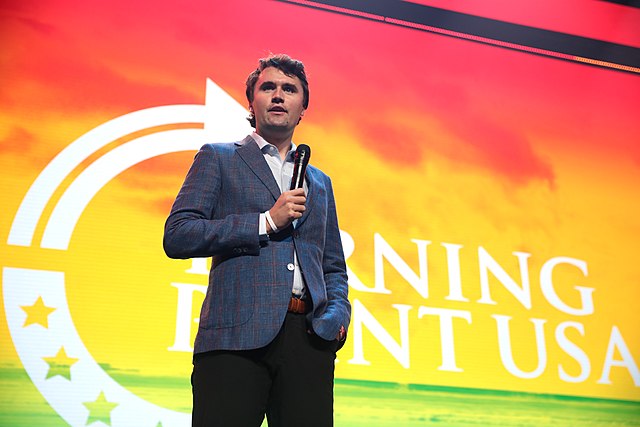
Cayden: I reached out to different faculty members for Sophia. We emailed four or five different people. A few of them said they were going to help us but didn’t want to put their face as the representation of it. But we finally found Bradizza and he’s been phenomenal.
Erica: Very knowledgeable in political science.
Sophia then mentioned, as Cayden had briefly stated, that some of the other faculty members that they had reached out to expressed interest in working with the E-Board and supporting them; but because they weren’t on tenure, they expressed worry that they might lose their jobs simply by associating with the club.
I find it interesting that not only has the club been receiving hesitation from the student body, but also from faculty members. It makes me curious as to whether there is a discussion surrounding this club controversy amongst the faculty and staff of Salve as well. And if so… what is the climate of the discussion?
Eleni: What is your club’s mission statement?
Erica: I think that the main mission of our club is to spread free speech across college campuses and open debates as students.
Sophia: We want to protect the constitutional rights that we have as American citizens and bring that diversity onto campus when it comes to political views and the views of students.
Cayden: Just being able to have civil conversations. I came from a high school where if you didn’t have the same view on a topic as everyone else you were the outcast. I just felt like that wasn’t fair; no matter what side you’re on you have the right to your own opinion and shouldn’t be hated just because of one view on a topic. That was something I always hated during high school and I want to change it during college because I don’t want my college experience to be similar to how it was in high school.
I then asked the E-Board a quick follow-up question.
Eleni: Was there a specific reason you wanted to spread this mission through TPUSA?
Sophia: I feel like we did definitely get to a point in America where it’s very divided; we are heavily divided just as a nation. And I feel like bringing this club into Salve is opening that dialogue where we can have reconciliation between each other and more unity by having both sides of the spectrum come together as one force.
Erica: I think the events of September 10th really shocked me, because a man was shot just for his opinions and ideas that people didn’t agree with.
Eleni: So do you think that there is some power in spreading this message and mission through this organization specifically, as opposed to just starting a club that’s just like a debate club where you can host conversations?
Cayden: I think Turning Point definitely has a reputation for itself but I think also the idea of it is saying, we don’t agree with necessarily everything to that extent either. There are things that just because the person who started it believes it doesn’t mean that everyone in the club or organization does and you kind of have to differentiate that. I feel like the overall values are staying the same.
Sophia: And in our constitution, it does say how we’re not allowed to directly support a political candidate for president (etc.) This needs to be definitely specified: Charlie Kirk was the founder, but Turning Point is separate from what his views are and what he was going for. But Turning Point is its own thing. That’s where a lot of the misrepresentation comes in.
In regard to this, the Salve TPUSA mission statement reads as such: “Turning Point USA’s mission is to educate students about the importance of fiscal responsibility, free markets, and constitutional rights through innovative campus activism and non-partisan, thought-provoking discussion.”
TPUSA’s mission and constitution are available on Seahawk Connection for all those who are interested or curious.
Eleni: How does TPUSA, specifically as a Salve club, align with Salve’s Mercy Mission and the Five Critical Concerns of Mercy.
For those unfamiliar with either, they are as such:
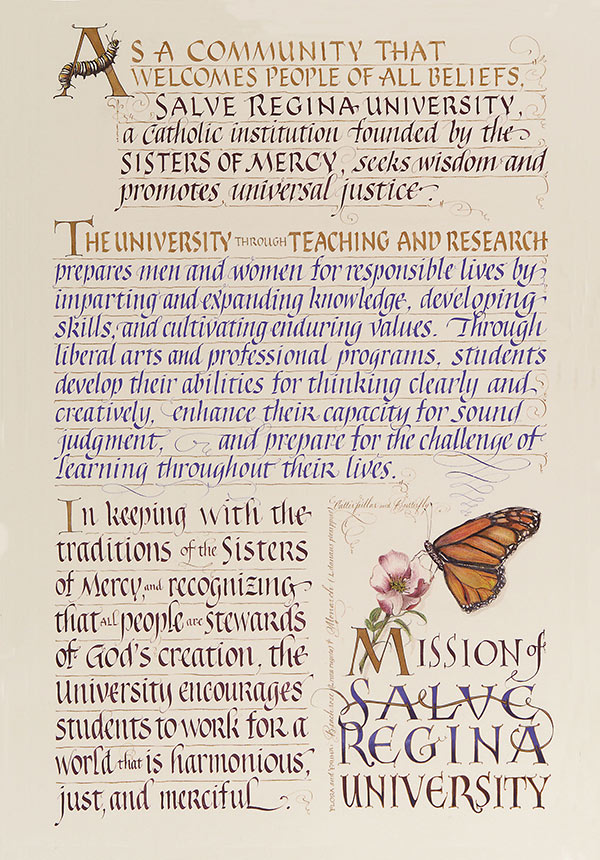
Salve’s Mercy Mission: “As a community that welcomes people of all beliefs, Salve Regina University, a Catholic institution founded by the Sisters of Mercy, seeks wisdom and promotes universal justice. The University, through teaching and research, prepares students for responsible lives by imparting and expanding knowledge, developing skills and cultivating enduring values. Through liberal arts and professional programs, students develop their abilities for thinking clearly and creatively, enhance their capacity for sound judgment and prepare for the challenge of learning throughout their lives. In keeping with the traditions of the Sisters of Mercy and recognizing that all people are stewards of God’s creation, the University encourages students to work for a world that is harmonious, just and merciful.”
Five Critical Concerns of Mercy: “Anti-racism, the Earth, immigration, nonviolence and women.”
Sophia: We are a board of all women. Over half of our members are women and we’re bringing a voice to that. We want to make sure to be inclusive and bring diversity to campus by having our voice spread. We want to make sure overall, Salve as a whole, becomes united as one again instead of being diverse as it is known to be.
Cayden: We want to be able to have those conversations together and not be divided. Kind of bringing everyone back together even though you disagree and at the end of the day saying “I might disagree with you on this, but we don’t have to hate each other because of it.”
Eleni: You just mentioned that you are hoping to return Salve to its “united” state and that right now it’s a little bit divided or diverse… Have you experienced that in any way? How do you experience that specific point?
Sophia: I feel like it was very prominent in our tabling event which did bring a lot of controversy. We realized how people are truly divided, because we will have people come up to us saying “We love what you’re doing, you’re doing amazing work.” And then we have people coming up that are verbally expressing their hate towards the club, towards the people. We just try to explain to them that we’re bi-partisan, so you can join the club and come sit at a meeting and talk and debate—and we can just expand; we’re not completely closed off. I feel like having a space where students’ voices, based on their beliefs, are heard is important. A controlled environment in a way.
Cayden: Not that I didn’t expect to be treated a little differently after starting this, but it’s definitely obvious. You can see the difference of people I talk to in the beginning of the year just completely cutting me off after a tabling event. When we were over there, we had the question up about transgender athletes. There were a few people that came up and were simply debating us nicely and I remember saying to them, “I might disagree with this [transgender athletes], but I don’t disagree with if you are gay, trans, (etc.)” I think they’re just taking the one point of view, that one stance and saying “You’re transphobic”—I’m truly not.
After this conversation, we moved onto the final question of the interview.
Eleni: We’ve already kind of touched on this. But are you aware of the controversy happening on campus and what is your understanding of it? From the standpoint of your club and maybe even separate from the organization, can you appreciate and understand why people might be upset about what’s happening on campus surrounding your club?
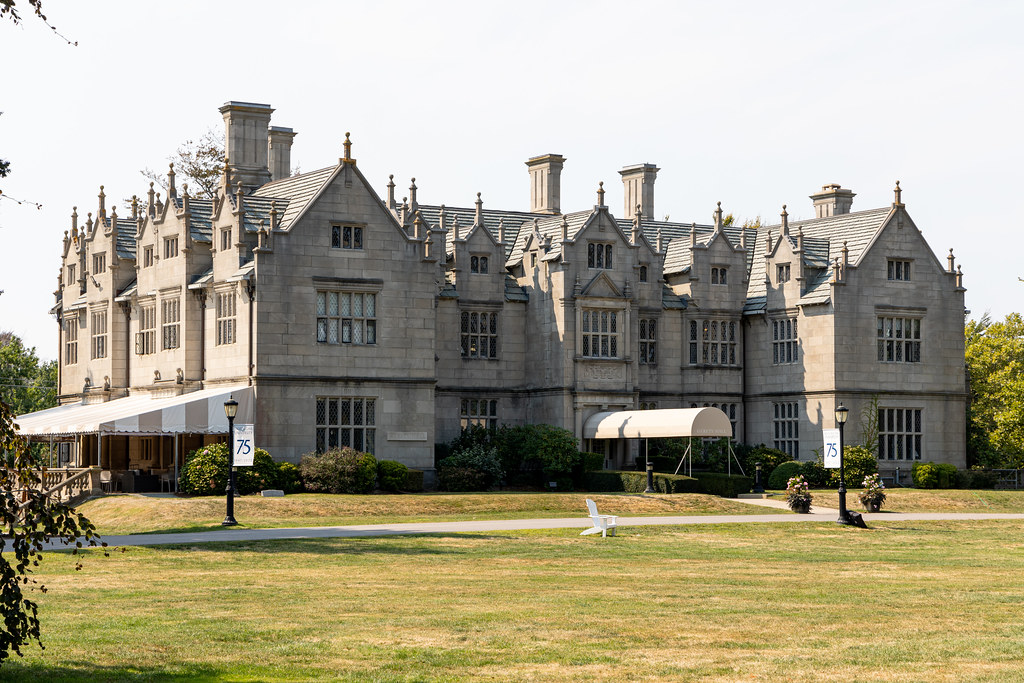
Sophia: I feel like there are a lot of misconceptions about what we are. I feel like people are not understanding or they’re choosing not to listen to what we’re having to say and just jumping into conclusions because of what the founder of the organization said. Every single belief that the founder supports, we might not directly support. We are not copy and paste of the organization. We are our own people with our own ideas, own thoughts.
Sophia continued on to mention how she believes that the reactions of some Salve students is directed more so toward them as students rather than the organization. So much so that it has gotten to the point of affecting the schooling and daily lives of each E-Board member. Cayden mentioned an incident where someone approached her in Miley Dining Hall and yelled at her.
Cayden: I was just like, I understand you’re mad, but we can do this civilly. If you were trying to just talk to me, I would’ve talked to you. I feel like I shouldn’t have to go around and be personally attacked everywhere; just like how I’m not going to go up to someone else and just start yelling at them because I disagreed with something they did.
Erica: Yeah, I feel like we have to walk on eggshells.
Eleni: So, do you think that you might be able to see a reason why people have misconceptions about your club?
Cayden: I think because it gets associated with Charlie Kirk a lot.
Erica: Charlie Kirk had some very controversial views that people think are the automatic thing.
Cayden: Because he founded it, people just assume that we’re going with everything he said, which is very different.
Sophia: I understand where people are coming from because it’s how you grew up.
Similarly to Eliza and Kendra, I then asked if there was anything else they would like to be known or mentioned in the article.
Cayden: I know there’s also been the misconception that a lot of clubs think that we’re going to show up to their stuff and protest what they’re doing. I can assure you we’re not going to. I have no intention of going to any other club and saying, “I disagree with that,” because I don’t. You have your free speech to run your club; we have our free speech to run our club. That’s what we’re promoting. We want those different clubs to talk about different things. As far as I’m concerned, if you do your own thing, we’re doing our own thing.
Eleni: One final thing. Were you aware that a student here started a petition?
They all voiced that they were very much aware of the petition. I then let them know that I had interviewed Eliza and Kendra.
Eleni: Both of them stated that they would be more than willing to have a conversation with you. Just kind of like you mentioned, a civil, casual conversation. Is that something that you would be willing to participate in.
Sophia: I definitely am willing. I got an email from one of the people from the petition asking to interview us, but I directed that person to this interview that’s going to be coming out and directed that person to attend one of our meetings.
Cayden: We’re definitely not opposed to talking about it. Show up to a meeting. We’ll talk to you. We have nothing to hide.
A big thank you to both Eliza and Kendra and the Salve TPUSA E-Board for allowing the Mosaic to cover this discourse on our campus. I appreciate everyone’s willingness to have a conversation and I hope that this can continue. I am hoping that by engaging in conversations with these individuals and writing this article, that this is just the beginning of a very important conversation that our campus should have. How do we create a safe, welcoming space where every view can be heard and accepted? Every story, every experience can be acknowledged, appreciated, and understood? As I mentioned initially, Salve is a wonderful campus that loves and welcomes diversity. Diversity is a spring of water in a drought and should never be scorned. AND! How can we include it in our community while also ensuring that we aren’t somehow excluding others from drinking from that same spring. I look forward to seeing what discussions will arise from this initial conversation.
*All parties mentioned gave verbal consent to be named in this article
Photos provided by WikiCommons, Flickr, and salve.edu.