By: Anonymous | Staff Writer
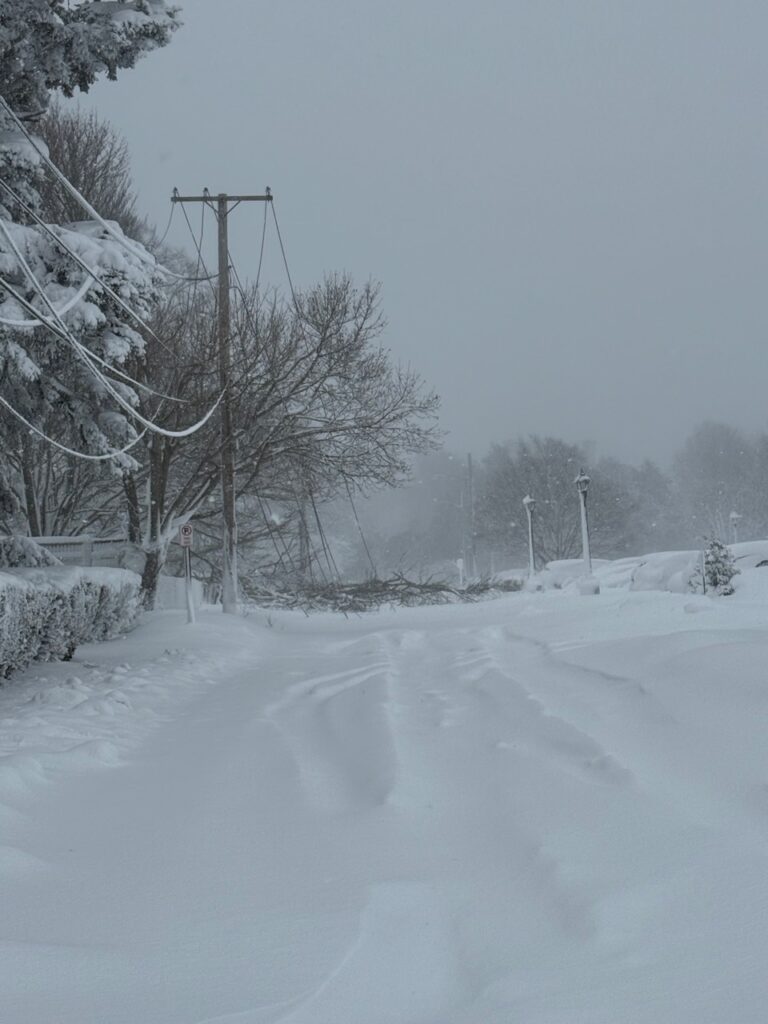
After an abnormally snowy winter compared to recent years, meteorologists predicted another snow storm, a last hurrah as weather had already started to warm up in preparation for the spring months to come. Predictions fluctuated on how much snow we should predict, but across the board there were reports of snow.
On Saturday, February 21st, Salve Public Safety alerted students and staff that in-person classes would be canceled for Monday, the 23rd. The evening of Sunday the 22nd, everyone in the area got automated emergency weather alerts, including a travel ban from hazardous weather conditions. It seemed a bit over zealous. The start time for the storm kept getting pushed farther and farther back. The snow started around 8:00 pm but even then, it came at a slow, steady pace. The sound of the wind was more distressing than the snow itself. Residential students were told to move their cars to various lots across campus for ease of plowing, and University President Kelli J. Armstrong was housing some essential workers overnight who would not be able to commute back and forth from campus in the snow, but so far those seemed to be the most drastic measures taken.
Around 5:00 am, the morning of the 23rd, Wallace Hall had a boiler rupture, and all residents had to be evacuated in the morning snowy weather because of carbon monoxide levels in the building. By this time the rate of snow fall had significantly picked up and conditions were far more hazardous. It was too early and the weather conditions were still too severe to give a timeline for repairs to the building, nor was anyone expecting such significant property damage.
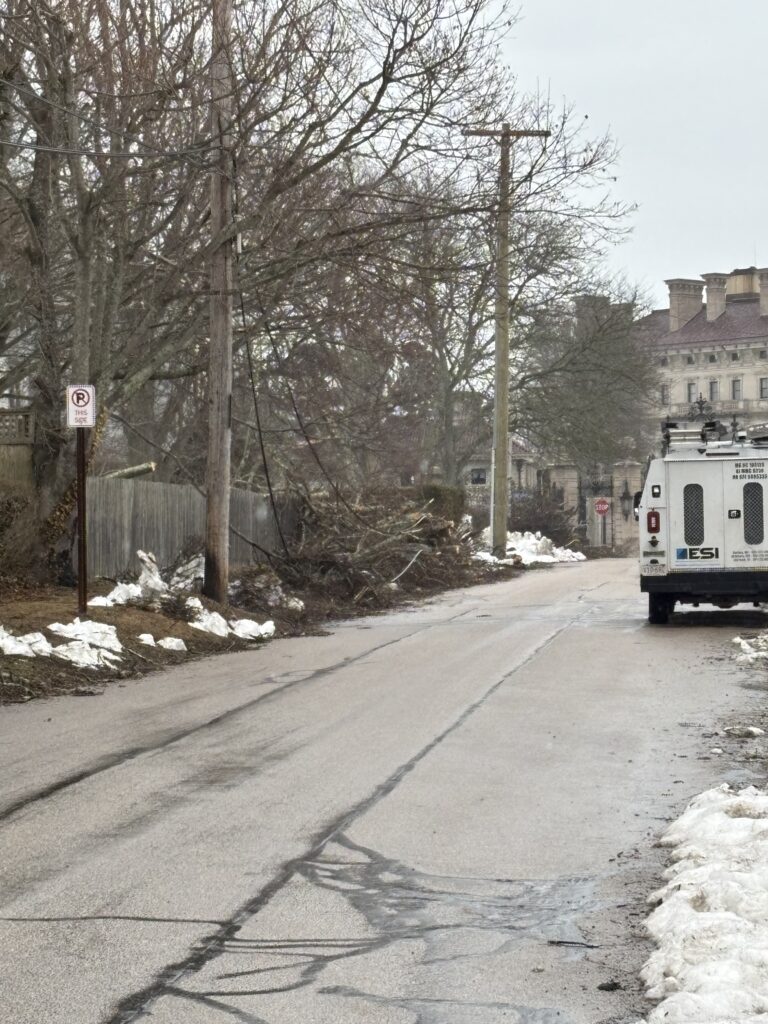
This was then followed by another housing disaster. Mid-morning on Monday a tree fell across Victoria Ave and tore down the power lines behind it. Trees were down across the city of Newport, farther up the island, and all over the state, however students were under the impression the buildings had operating generators and were not told to prepare for power outages. Students received very little communication about when we should expect power back or measures to take throughout the outage. One of the most pressing issues of the power outage was the inability to open the buildings that required an ID to enter, unless someone was inside already to open the door. This made traveling to parts of campus with power a risk; there was a chance students wouldn’t be able to get a hold of anyone to let them back in.
The snow and wind were persistent throughout the rest of the day, and with no end in sight students within a realistic walking distances took it upon themselves to walk to the one building open to all students that was confirmed to still have power, heat, hot water and meals (and for some the motivator was coffee). Miley Lounge and Dining Hall had its capacity tested. There were students sitting on the floor and charging devices in the doorway.
It is worth noting that students who lived in buildings closer to Bellevue Ave such as Watts, Young, Fairlawn, and Stoneacre had little way to access the main body of campus. Walking from the buildings on Lawrence to Miley was enough of a struggle. A normally eight-minute walk easily doubled in time from the snow on the road, the wind, and the low visibility. That twenty/twenty-five minute walk was extremely treacherous in the storm.
The champions of Miley were the student employees who got Miley Mart up and running, even when it was presumed to be closed, the dining services staff who were operating on a shoe-string team and stayed at the campus until the travel ban was lifted again, and the ResLife staff, especially the RAs, who were the primary line of communication between students and leadership at Salve.

On Monday afternoon a notice went out that Salve would not be having in-person instruction. It seemed as though professors were still being permitted to host online classes. At this time no one had been given a timeline for power returning to campus, much less the rest of the city. Professors later clarified the university had directed them to completely cancel classes, and to be flexible with deadlines as electricity returning and road clearance were going to be occurring on a rolling basis and the island was not equipped to handle the snowfall. Residences in the Fifth Ward didn’t have streets cleared until Thursday.
On Monday evening, ResLife gave notice that the ground floor of McKillop would be opening, and both it and Miley Lounge would be open 24/7 until power was fully restored. RAs would go on to take overnight shifts in both locations to account for students choosing to spend the night in either location as opposed to dorms that had temperatures dropping into and below the 50s. Students carted mattress toppers, pillows, and blankets to both buildings and set up camp to wait out the power outages. Others chose to wait it out in their own rooms. With snowfall set to stop around 6:00 pm, students predicted that once roads were cleared and Rhode Island Energy was able to get to campus, power would be restored sometime in the night or the next morning. By this time power had started to come back to some off-campus residences as well, which helped fuel the hopeful feeling.
The hopeful feeling was right. With the exception of Hunt and Reefe, which were entirely dependent on the downed wire, power was restored across campus by mid-morning on Tuesday the 24th. Hunt/Reefe were instead running on a partial generator which was providing electricity to common spaces and a low level of heat, but not enough to run the buildings at full capacity.

It was around this same time that the community got official word of tragic news: Joseph Boutros, a 21-year-old Criminal Justice and Criminology major, had passed away of carbon monoxide poisoning the night before. The university was already fragmented and frazzled trying to handle the environmental effects of the storm. The loss of one of our own was a deep wound for many, especially his teammates, friends and family. As the weather cleared up, students were given opportunities to honor Joseph’s life. Plans for a vigil were formed, and mass the following evening was to be given in his honor.
As generous as the community had been to students, who very well may be experiencing their first severe weather event without the guidance of their families, the goal was for operations to return to normal as soon as possible. Students needed to get their cars out of The Breakers’ parking lot by the end of the night, with the goal of the preservation society to be able to get onto the grounds the next day. The task was daunting as plows were only able to get so close to the cars, and because of the force of the wind, some cars had snow blown underneath them, making them even harder to move. Salve prides itself on community, and community we saw. Sports teams were out helping to clear out the lots, and music could be heard playing well after the sun went down.
It was Tuesday night when the students with long-term housing problems were relocated to the Marriott Hotel in town to wait out campus restoration. All Wallace residents were moved, and students in Hunt/Reefe had the option to be shuttled over. Hunt/Reefe had power restored the following day and students were returned to their Residence Halls. Full repairs and air testing were completed in Wallace by the end of the week, and students returned to Wallace over the weekend. This, paired with the ability for professors to start running online classes in lieu of normal instruction, marked the slow return to normalcy for campus.
In a true sign of community from Salve Regina University, students, faculty, and staff who were able to attend came together for mass the night of Wednesday the 25th in honor of Joseph’s life. It was moving to witness the gesture. So many people came out in support of each other that there wasn’t enough room for everyone to sit. The chapel was lined with everyone’s respect for life, loss, and Joseph.
After a record breaking 34 inches, the weather is warming again, and the snow is melting. Classes returned to normal Monday the 25th, but the campus will carry the mark of the past week for a long time. We’ll remember the frustration and struggle, but we will also remember the ways in which we were able to show up for each other, in ways we would never expect to need to.
Photos provided by Author, Instagram